
Anthropic is a remarkable business, in more ways than one. Revenue has gone from $41m in 2023 to about $16.9bn in a single quarter, it made an operating profit in the second quarter, and its customer base has broadened sharply. It has launched a dizzying array of products and features for business, several of them category leaders in their own right.
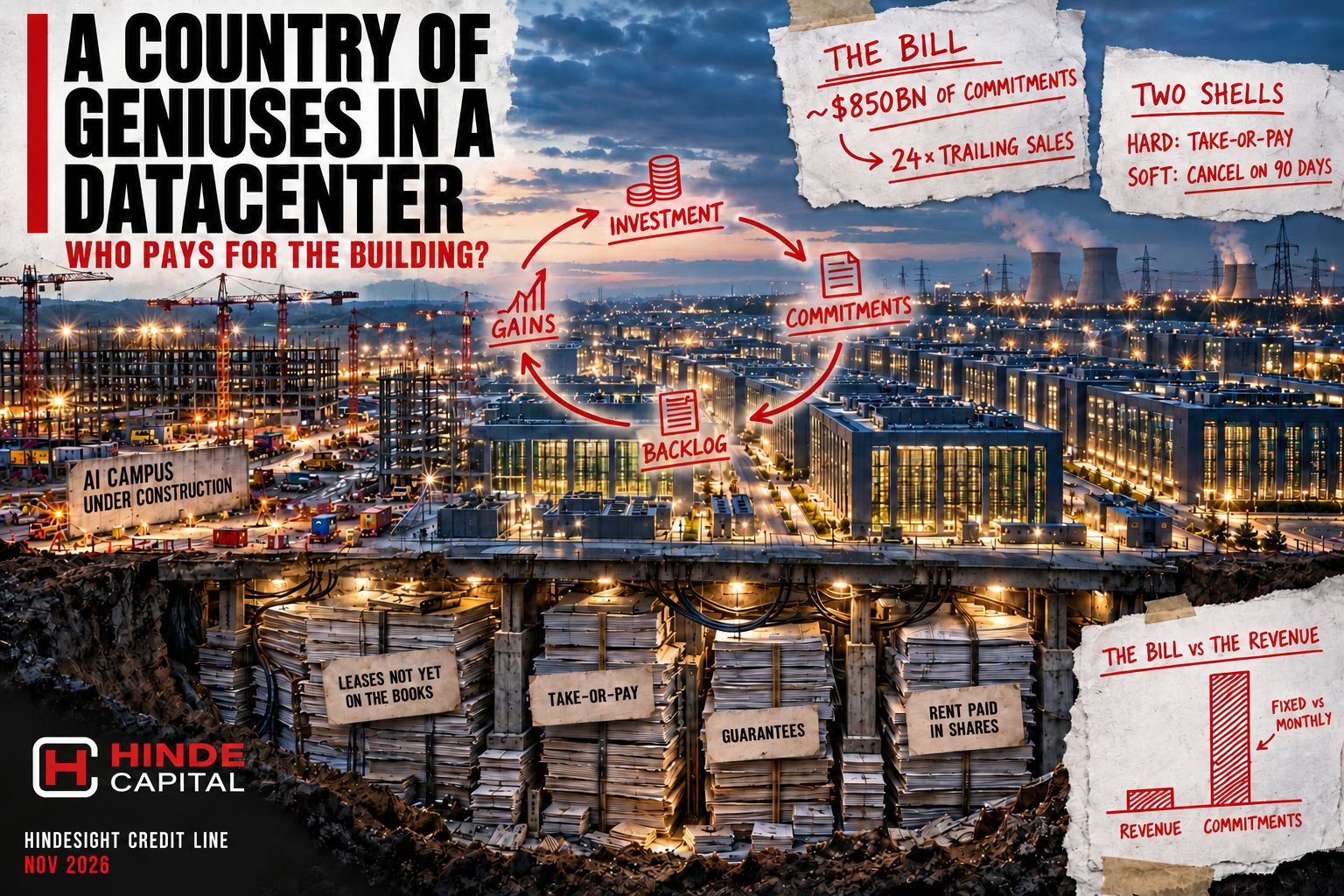
Its filing also shows, for the first time, the bill for the build, roughly $850bn of compute commitments, more than twenty times a year's revenue, fixed for a decade while revenue is earned month by month. Most of its compute trains the next model and earns nothing directly. The margin on serving customers pays for it, and that margin is under pressure as token prices fall and each new chip resets the price of compute. Anthropic signed hard contracts with the strongest counterparties and soft ones with the weakest, so if growth slows, the neoclouds and their lenders feel it first.
The money moves in a circle. The hyperscalers invest in the lab, the lab commits to their clouds, they book gains on the stake, and the suppliers lend to their customers and are repaid in shares. Much of the debt sits below the line, in joint ventures, special-purpose vehicles and guarantees booked at nil, rated investment grade and held by insurers. The borrowers are drifting down Minsky's ladder, the debt window is narrowing, and the hyperscalers that stand behind it all have started selling shares.
The geniuses are real. The question is who pays for the building, and when.
A Country of Geniuses
In October 2024, Dario Amodei, co-founder and chief executive of Anthropic, published a long essay called "Machines of Loving Grace". It set out what powerful artificial intelligence (AI) might achieve if things went right, with decades of progress in biology, medicine and economic development compressed into a handful of years. Its follow-up, "The Adolescence of Technology", published this January, confronted what could go wrong. Both rest on the same image. Powerful AI, he wrote, could be summarised as "a country of geniuses in a datacenter".1
It is a remarkable phrase, and a serious one. This letter takes it seriously. It simply asks a question the essays were never meant to answer. Who pays for the building?
Geniuses need somewhere to live. These ones live in data centres someone borrowed to build, on chips someone has leased, powered by turbines someone has contracted, rented on terms someone has to honour. For most of the past two years that bill has been hard to see. It sat in footnotes, joint ventures and special-purpose vehicles, below the line. On 26 October, Anthropic filed to list its shares.2 For the first time we can read the bill from the inside, and see what the geniuses earn, what they cost, and who is owed the difference.
Credit first, where it is due, to Anthropic's founders and its team. Dario Amodei is the public face, but behind him stands a remarkable team. Anthropic's rise has been nothing short of meteoric, from $41m of revenue in 2023 to around $16.9bn in a single quarter this year.2 I use its models, alongside other frontier and open-weight providers, for different agentic work, and the pace at which product has followed the models has been extraordinary. Through Epic Life, I was among the first of a growing line of founders building personal health agents. Building an application layer even three years ago meant stitching together rudimentary models with appalling context and memory. The labs have eaten our lunch. Fair play.
Which raises the question the title also carries. Who are the geniuses? The models, or the founders and chief executives spending hundreds of billions to house them? The market has lately voted against the build, most visibly in the neoclouds, and plenty ask who the market is to vote against the operators. Operators and investors bring different traits to the party. Every founder needs a measure of delusion; it is what offsets the reality served up daily, often hourly. Having co-founded several fintechs, I mean that as a compliment. But operators are paid to believe through the dips. Creditors and equity holders are paid for surviving them.
That is the thread of this letter. The question is not whether the geniuses are real. It is whether the structure built to house them can survive the time it takes them to pay their way. On our arithmetic from Anthropic's own filing, its compute commitments come to roughly $850bn, more than twenty times its revenue over the past twelve months.2 The company may well grow into them. The point is that the obligations are fixed, and the revenue is not.
This is not a view on Anthropic's shares. It is a credit letter, and Anthropic is its case study because it is the best-disclosed company in the chain. Almost every name in our Below the Line tracker connects to it: the hyperscalers that are its landlords, lenders and shareholders; the chipmakers whose kit it rents; the neoclouds that hold its most flexible contracts; and the bondholders and insurers who financed the buildings. If the best-disclosed lab looks like this, the opaque ones deserve more scrutiny, not less.
What follows starts with the company and its growth, then turns to the price of compute and of a token, to the bill and who signed for it, and to the structures that keep much of it off balance sheets. It ends with where the risk sits, what would prove this wrong, and back at the building.
Adam and the ANTs
Every creation story needs an Adam, and this one has a ticker to match. Whatever one thinks of the financing, the business underneath it is real, and growing at a pace that has no precedent at this scale.
Anthropic's revenue was $41m in 2023, $386m in 2024 and $4.59bn in 2025. In the first half of 2026 it was $16.29bn, against $1.16bn a year earlier. The second quarter alone brought in $11.56bn, an annualised rate of about $46bn, and the filing implies the third quarter reached about $16.9bn, since it puts third-quarter revenue at 86 times the $197m of the fourth quarter of 2024.2
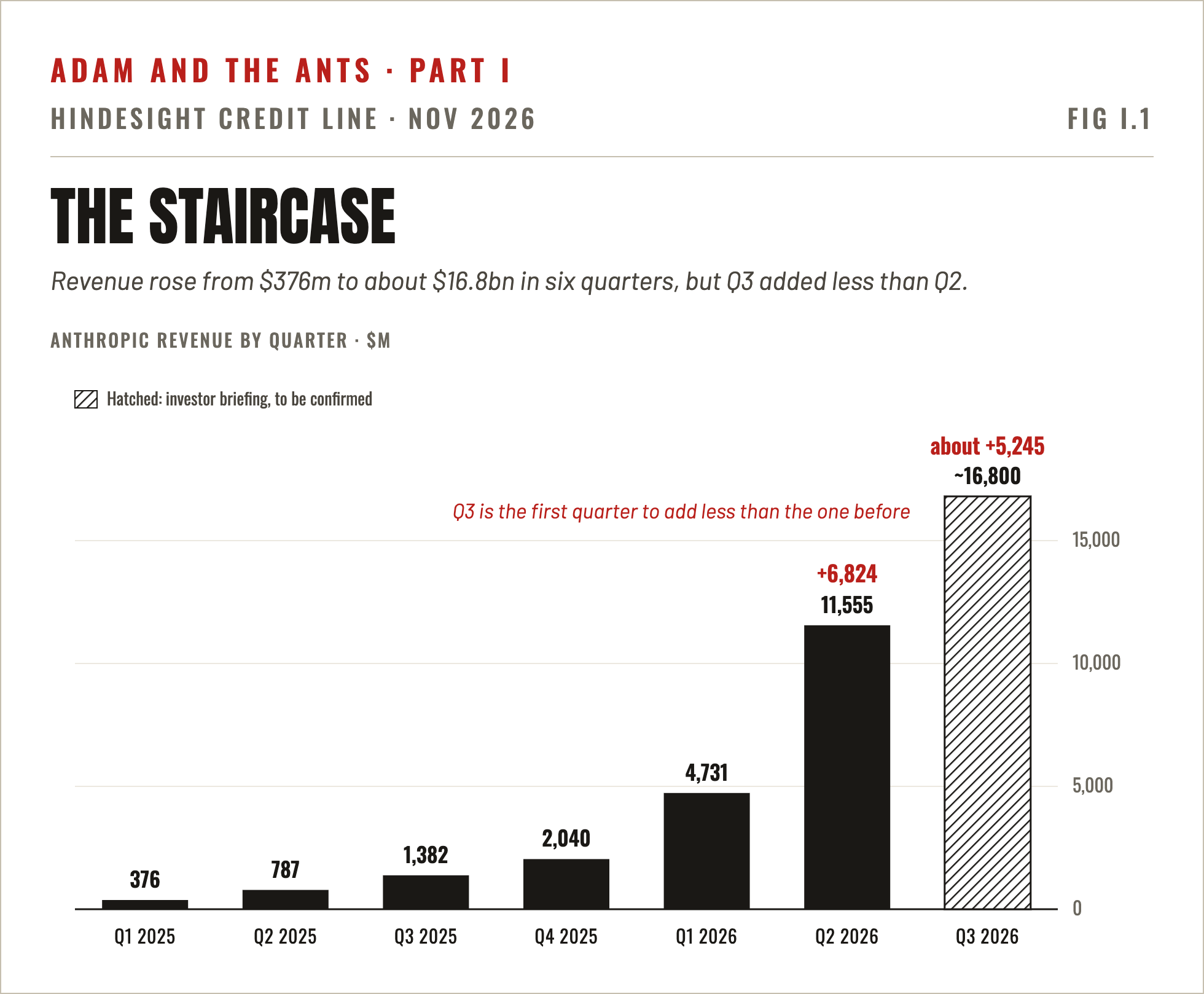
HS Chart NoteRevenue rose from $376m to about $16.8bn in six quarters. The third quarter was the first to add fewer dollars than the quarter before: about $5.2bn against $6.8bn. Still extraordinary growth, but the steps are shortening as the long-dated commitments begin. Q3 figure from the company's investor briefing, to be confirmed in the amended S-1.
Open full size →The staircase tells two stories. The first is the scale, from $376m in the first quarter of 2025 to $16.9bn six quarters later. The second is the step. The third quarter was the first in the series to add fewer dollars than the quarter before, about $5.4bn against $6.8bn in the second. Still extraordinary growth. But the steps are getting shorter just as the long-dated bills begin to land. We will learn more in the amended S-1, due mid-November.
The business is better than its headline loss suggests. It made an operating profit of $974m in the second quarter and generated $3.9bn of cash from operations in the first half. The $80.7bn net loss for the half is more than accounted for by two non-cash charges, $72.4bn for the rising value of its convertible notes and $9.4bn on agreements to issue more, together $81.8bn. Most of those notes are held by the same companies that rent Anthropic its compute.2
The customer base has broadened dramatically. Customers paying more than $100,000 a year rose from about 950 to more than 11,900 in the twelve months to September. More than 1,900 now pay over $1m, and about 250 over $10m. The top five customers produced 36% of revenue in the first quarter and 21% in the third, and no single customer accounts for more than 10%.2 A year ago this was a business dependent on a handful of buyers. It no longer is.
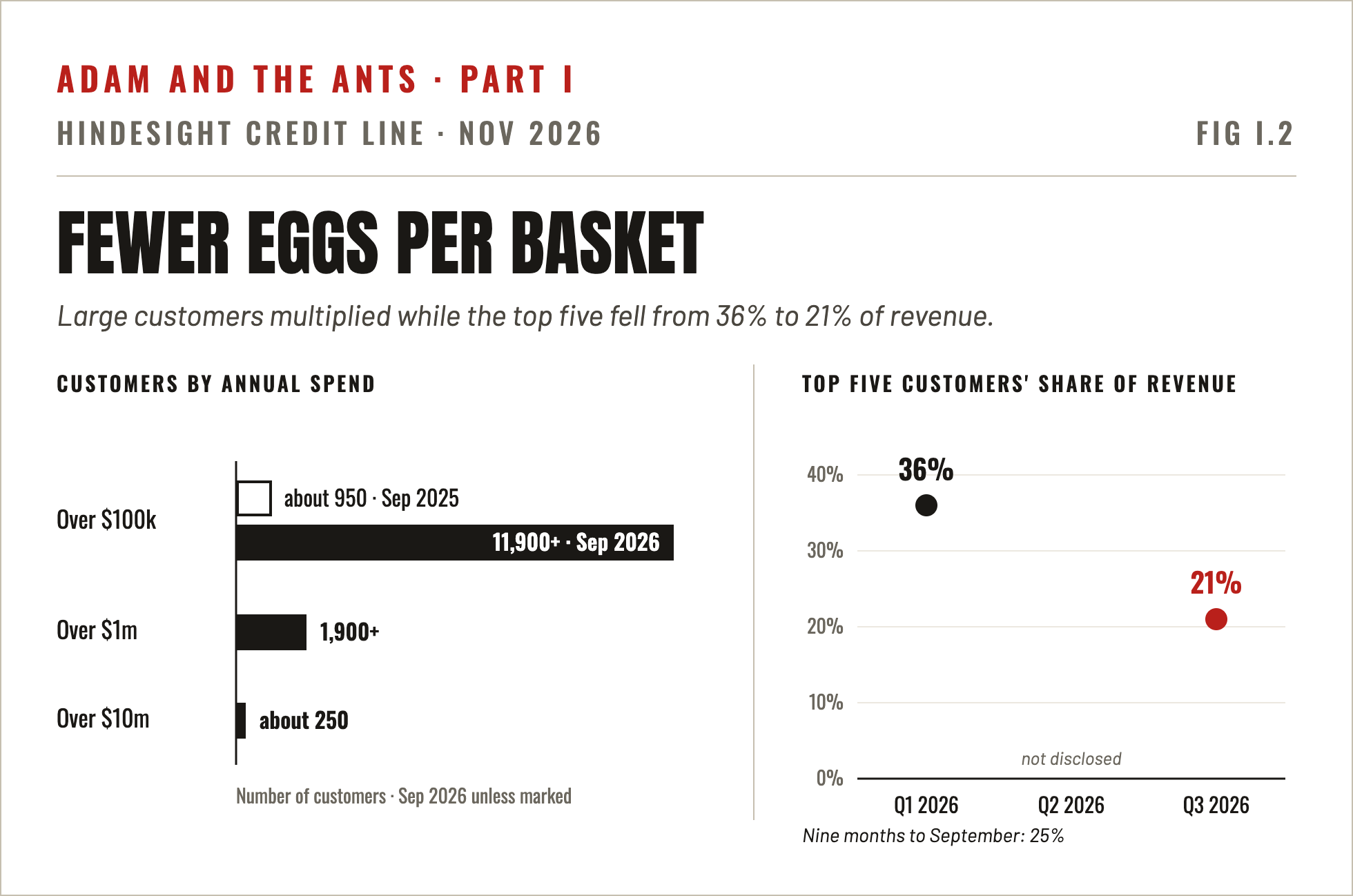
HS Chart NoteCustomers paying over $100,000 a year rose more than twelvefold in a year, and the top five fell from 36% to 21% of revenue. No customer is now above 10%. A business that depended on a handful of buyers no longer does.
Open full size →Four caveats travel with that progress. Revenue is mostly consumption, 80% of it paid per token, and consumption can fall as fast as it rose; many of the largest customers are not on long-term contracts. Between 5% and 7% of revenue in the nine months to September came from customers breaching Anthropic's usage policy or commercial terms, including distillation by rival labs, among them Chinese labs the company named in February. That revenue is now being enforced away.2,3 Models released in the previous six months produced more than 80% of third-quarter revenue, a treadmill that only keeps turning if the next model keeps coming. And 48% of revenue passes through the cloud marketplaces of Amazon, Google and Microsoft, booked at its gross value, with the platforms' cut counted as a cost.
The Compute Inside the Margin
The filing's most revealing table is its split of costs by function. In the first half, the cost of revenue, the compute that serves paying customers, was $2.38bn, against revenue of $16.29bn. That is a gross margin of about 85% on the company's own allocation, against 12% a year earlier. But the total compute bill was $8.95bn. Most of the remainder sits in research and development, which covers training the next model, research and internal use.2
On the company's allocation, the compute charged to serving paying customers is about 27% of its total compute expense; the rest sits mainly in research and development, including training, research and internal use. Measured against all compute, the margin was about 45% for the half and about 52% in the second quarter. The company itself says it deploys compute as a single shared pool, so the line between serving and training is management's allocation. The conservative measure is the one that matters for credit, because the cash left after paying for all compute, including the next model, is what has to meet the commitments.
Inference is the work of running a trained model for customers, as distinct from training it. The inference margin, in other words, is not profit. It is what pays for the next model. Cut it from 70% to 30%, with serving costs unchanged, and gross profit per token falls by more than 80%.
The third quarter offers the first test. Anthropic told investors it earned $1.70 of revenue for every dollar of compute, down from $2.08 in the second quarter, on the same basis as the filing.4 That implies compute spending of about $9.9bn in the quarter, up 78%, against revenue up 45%. At the margin, each extra dollar of compute brought in about $1.21 of new revenue.
The causes are not yet separable. Contracted capacity arrives in steps, whatever demand does. Short-term compute has been bought at higher prices. More may be going to training. Enforcement removed revenue without removing the compute contracted to serve it, and summer always dips. And prices are falling by design. Anthropic says its September models cut customers' cost per task by about 25% and 40%, through a mix of lower prices and greater efficiency.2 A 40% cut means usage must rise by about two-thirds just to earn the same from the same work. What the industry now calls valuemaxxing is cost control for the buyer and price pressure for the seller. The amended filing's split of third-quarter costs by function will show which it is.
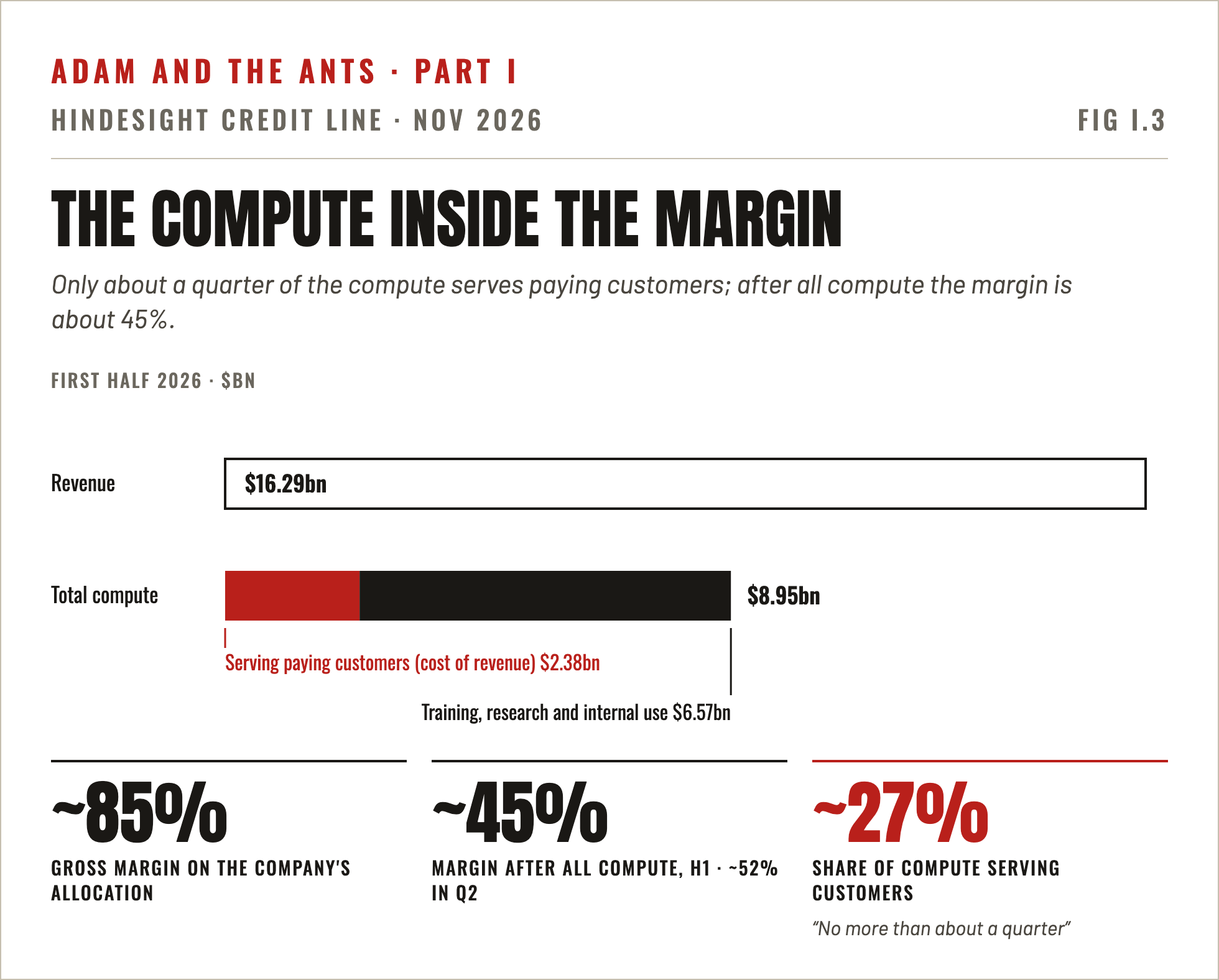
HS Chart NoteOnly about a quarter of Anthropic's compute serves paying customers. The rest trains the next model or runs research. On the company's split the gross margin is about 85%; after all compute it is about 45%. For credit, the second number is the one that pays the commitments.
Open full size →One further force cuts both ways. Amodei writes that AI already writes much of Anthropic's code, and that the loop may be a year or two from the current generation building the next unaided.1 Recursive self-improvement (RSI) can cut the cost of each unit of intelligence. It can also pull ever more compute into training, and shorten each model's commercial life. Scaling, as he concedes, is not certain, though it has a decade of evidence behind it. Its path is an exponential with oscillations around it. Equity can look through a dip. Debt sized on the trend has to survive it.
Not all of that compute is Anthropic's own. A good deal of it is rented, and one of the largest landlords is a company whose owner spent the weekend before the filing warning that debt markets had shut.
SpaceX Oddity
Ground control to the neoclouds. Over the weekend before Anthropic filed, Elon Musk told his followers that there would be "a lot of stranded compute in partially complete data centers", that debt markets had "almost entirely shut off" for companies without substantial revenue outside AI data centres, and that the 200-plus neoclouds faced "guppy-level death". SpaceX, he added, had closed $40bn of debt for GPUs, because it was investment grade and had Starlink and launch revenue behind it.5
He has been consistent. A week or so earlier he said there was no demand problem, and that compute would be worth more per watt every year.5 Strong demand and failing finance is the diagnosis this series has made since August. The build is too slow, and the money is getting harder to find.
But a market's most prominent voice does not just describe a funding window. He can help close it. Lenders read his posts too, and markets are reflexive, so statements about a market change the market they describe. My read is that he is using his singular weight to say "I'll own it", or at least to own it with the others. Plenty of municipalities would rather not host a Musk data centre, so the faster route to capacity runs through the operators who already have land and power, and whose funding he has just made harder to find. Whatever the intent, the effect favours SpaceX.
The neolabs had already shown why it matters. One told Yuchen Jin that even if it failed to train the best model, it had locked in GPU capacity early and could simply "resell the compute and print money".6 That works while rents rise. Compute that sits in a half-built hall, without power or cooling, cannot be resold at any price. Today's print-money trade is tomorrow's distressed sublet.
What SpaceX Actually Filed
The $40bn is not what the post implied. SpaceX's filing on 26 October describes a binding commitment, not a closed deal, to enter a master finance lease with an entity managed by Apollo, the asset manager that owns the life insurer Athene. The Apollo vehicle will buy the GPUs and lease them to SpaceX in tranches of about five to five and a quarter years each, paid quarterly in advance. Each payment is one-twentieth of a tranche's cost plus a fixed rate of interest, on about $40bn of principal in all. The leases are subject to closing conditions and are expected to begin in the first half of 2027.7 The $10bn of bank loans and $30bn of investment-grade bonds reported in early October was the proposal, since superseded.8
In fairness, the structure is sound. It amortises fully over roughly the useful life of the chips, which leaves no large balloon for anyone to refinance. In Minsky's terms it is hedge finance, and better built than most of what follows in this letter.
But SpaceX pays whatever the GPUs earn. If AI compute disappoints, Starlink and launch revenue carry the cost. Investment grade makes that cross-subsidy credible. It does not make the risk disappear.
Not Outside the Loop
And SpaceX sits squarely inside the loop it warns about. Part of its own business is, in effect, a super neocloud (a hat tip to the SuperGrok subscription I use to search sources), renting compute to others as well as using it. Anthropic's filing shows a contract with SpaceX's AI unit worth up to $120.5bn into 2029, about $3.1bn a month at full capacity, expected by December. That is more than half of Anthropic's current monthly revenue. Once the initial periods end in January and March 2027, either party can cancel on 90 days' notice.2
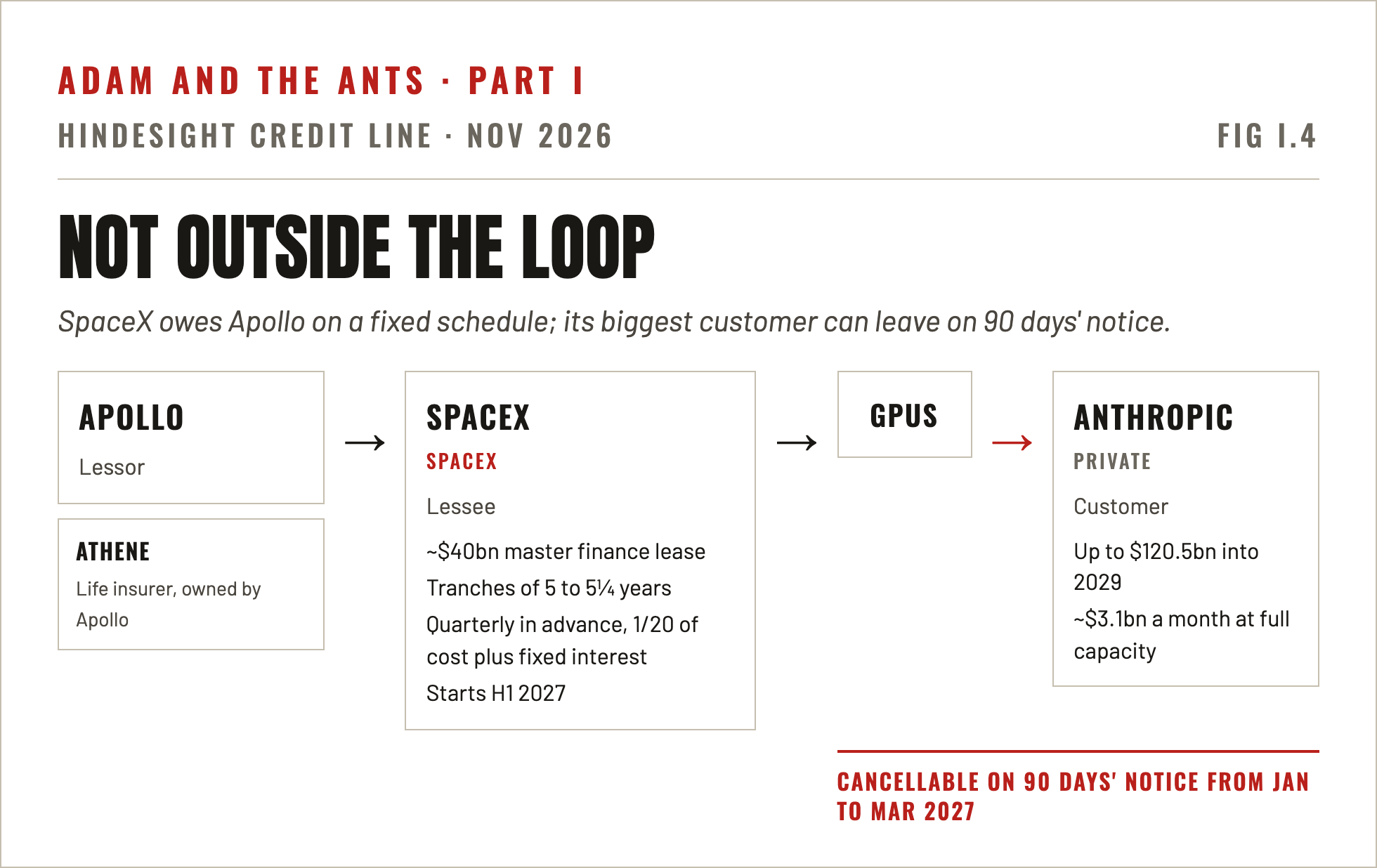
HS Chart NoteSpaceX pays Apollo whatever the GPUs earn; its biggest customer can leave on three months' notice from early 2027. Short contracts reprice upwards in a shortage and downwards in a glut. Starlink and launch carry any shortfall.
Open full size →Short contracts are the SpaceX model, keeping terms short so prices can rise in a shortage. They also reprice downwards in a glut, and they let the tenant walk. If the neoclouds Musk expects to fail dump their capacity, and the neolabs become sellers of what they hoarded, rents fall, and SpaceX's short contracts feel it first.
The same names keep reappearing on both sides. Apollo is SpaceX's lessor. In June, Apollo and Blackstone also raised about $35bn for the vehicle that buys Google's tensor processing units (TPUs) and leases them to Anthropic, a special-purpose vehicle formed by Apollo's Atlas SP Partners.9 Through Athene, that means an insurer's balance sheet; we return to the insurers in Part III. The credit market has noticed. SpaceX's five-year credit default swaps traded at a record 226 basis points in the week of 19 October, up from 110 when they began trading in late June.10
In a circular system, the risk a warning creates comes back to the one who issued it. Which brings us to the price that decides who is right, the true worth of compute and of the tokens it produces.
Sources
- 1Dario Amodei, Machines of Loving Grace, 2024; The Adolescence of Technology, 2026. Machines of Loving Grace · The Adolescence of Technology ↩ a b
- 2Anthropic, PBC, Form S-1, 26 Oct 2026. Used for: $850bn and the twenty-times multiple are HindeSight arithmetic; third-quarter 2026 revenue was 86 times fourth-quarter 2024 revenue of $197m; about $16.9bn is HindeSight arithmetic on the filing's rounded figures; MD&A and Note 8; margin after all compute, the quarter-share of compute and the marginal ratio are HindeSight arithmetic. Form S-1 ↩ a b c d e f g h i j k
- 3Anthropic, Detecting and preventing distillation attacks, 23 Feb 2026. Anthropic ↩
- 4Financial Times, Anthropic investor briefing, 14 Oct 2026. Financial Times ↩
- 5Elon Musk, posts on X, 24 and 25 Oct 2026; mid-October remarks via interview clip. Post, 25 Oct 01:32 UTC · Post, 25 Oct 19:11 UTC · Mid-October remarks (transcript) ↩ a b
- 6Yuchen Jin, post on X, Oct 2026. Post ↩
- 7Space Exploration Technologies Corp., Form 8-K, 26 Oct 2026. Form 8-K ↩
- 8Financial Times, 6 Oct 2026, via Reuters. Reuters ↩
- 9Financial Times, "Apollo and Blackstone raise $35bn in chip financing deal for Anthropic", 10 Jun 2026. Financial Times ↩
- 10Financial Times, via Financial Post, "AI debt worries spark surge in default insurance trading", 20 Oct 2026. Financial Times · Financial Post ↩
The small print. Worth a read.
This is not investment advice. HindeSight is one person’s attempt to make sense of the world and its markets. As a trader, I will invariably have positions that reflect some of the views expressed here, so there will be occasions when I am talking my own book. I make no apology for that, but it is something the reader should be cognisant of.
I write HindeSight as much for my own edification as anything else. The process of committing thoughts to paper forces me to test a thesis, join a few dots and occasionally discover that some of the dots had no business being joined in the first place. If, in doing so, it helps others frame their thinking or piques their curiosity, all the better.
There is no prescribed publication schedule. The letters tend to be born out of curiosity, conviction or an intellectual itch that needs scratching.
Markets are dynamic and so, by necessity, are my views. It is perfectly conceivable to be tactically bearish and thematically bullish on the same market. Equally, what seemed a compelling proposition on Monday may look rather less so by Friday. There is little virtue in remaining faithful to a thesis simply because one has committed it to paper. The art of trading, as ever, lies in marrying conviction with flexibility.
The objective is not to be proved right, but to make a return commensurate with the risk undertaken, capturing as much of the opportunity as possible whilst giving as little back as possible. Easier said than done, as most of us who have spent a lifetime in markets can attest.
Hinde Capital no longer manages external capital and there is nothing here to sell you. These letters are shared in the spirit of intellectual curiosity and the enjoyment of exchanging ideas. By all means challenge my thinking, but do your own work, take responsibility for your decisions and never take more risk than affords you a decent night’s sleep.
Nothing published here constitutes an offer, solicitation or recommendation to buy or sell any investment or financial instrument. Past performance is no guide to future returns. Readers should seek independent, regulated financial advice where appropriate. To the extent permitted by law, no liability is accepted for losses arising from reliance on this material.
By all means share the letters with your sister-in-law or brother-in-law. Whether you remain on speaking terms is, however, beyond the remit of this disclaimer.
© Hinde Capital 2026.